

sec@brattonhistory.co.uk
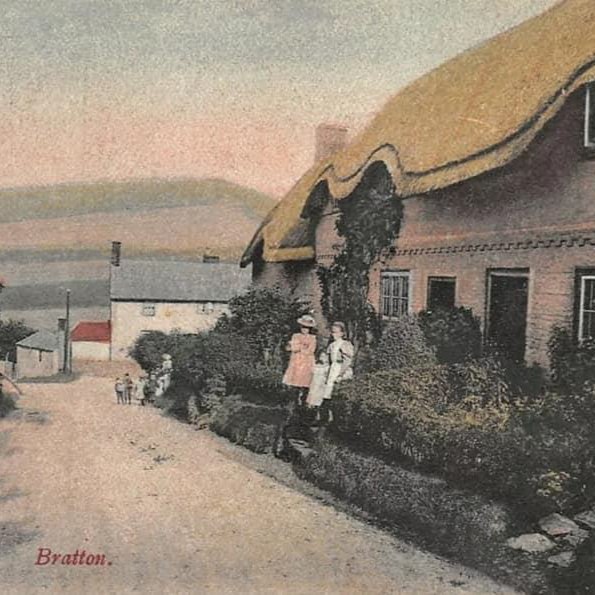
|
"The Murder House" - Melbourne StreetUntil it was demolished in the 1950s, the thatched house opposite Flowers Farm, was known locally as “The Murder House”. It became known as such following the trial and conviction of Rebecca Smith, the last woman in Britain to be executed for the infanticide of her own child. For many years the house, known as “Whites”, was divided into cottages for farm labourers and it is thought to be where Rebecca lived with her drunkard of a husband, Philip. Rebecca started life as the daughter of a successful “yeoman” farmer and a devout member of Bratton’s strong Baptist community. She married Philip Smith, a farm labourer, in 1831 and their first child, Jane, was born a year later. Rebecca and Philip had nine more children, none of whom lived more than a few months, and the infants were all buried in the Bratton Baptist Chapel cemetery. In 1846, Rebecca inherited £100 from her family and she, Robert, and their only surviving daughter moved to Westbury. But Philip had squandered the inheritance by the time an eleventh child was born in 1849. The baby died after a few days and rumours that Rebecca had bought poison from the local chemist led to his body, and two of those who had died in Bratton, being exhumed. All three bodies were found to contain arsenic. Rebecca was tried in Devizes and was sentenced to death, after which she confessed to using rat poison from hayricks to kill seven of her other children while in Bratton. Despite a campaign to save Rebecca from the gallows, she was publicly hanged in Devizes in August 1849. Of Rebecca’s 11 children, only Jane, the eldest, survived. She emigrated to Australia as an adult to escape the stigma. Sadly, it was not uncommon for mothers living in poverty to turn to infanticide if they were unable to feed their family. Often local communities would turn a “blind eye” to the death of very young children, as infant mortality was fairly high at the time and there was little else that women could do to limit the size of their family as birth control was not widely available. One can only speculate whether Rebecca would have suffered the same fate had she stayed in Bratton among people who knew her circumstances better. [Return] |
Bratton History Association.
The Bratton History Association aims to provide all those curious about local history with an opportunity to meet, exchange ideas,
and discover more about the history of Bratton and Wiltshire. Activities include monthly meetings, talks by professional historians,
visits to places of interest to historians, and our own local history project.
Copyright Bratton History Association 2015-2026
Bratton History Association Privacy Statement
Copyright Bratton History Association 2015-2026
Bratton History Association Privacy Statement
Web Design by Blue Engine Web Development © 2008-2026