

sec@brattonhistory.co.uk
|
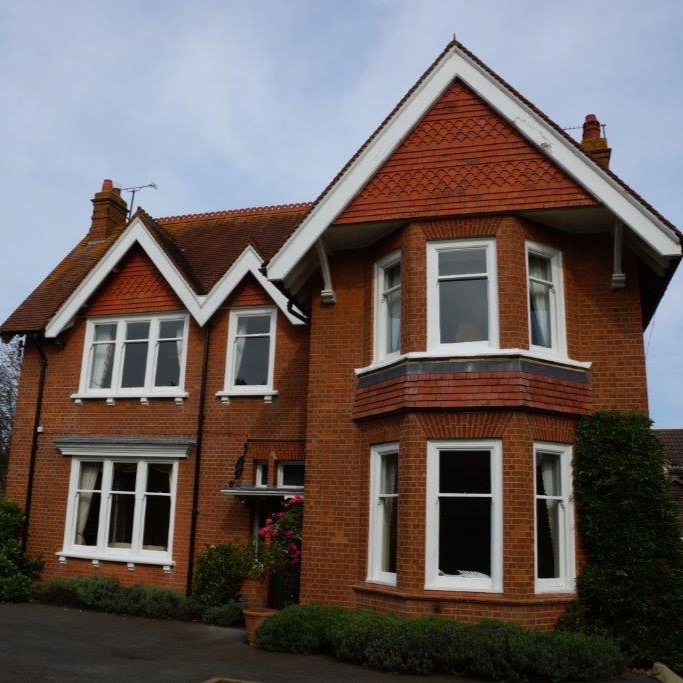
Tynings House - Tynings LaneIn 1902, as Bratton celebrated the Coronation of Edward VII, a new generation of the Reeves family (Oswald, 30, Robert, 27, and Nelson, 24) took over the Ironworks. In the same year Nelson's father Thomas paid £200 for the “Valuable orchard and garden with 2 pig-styes and tiled shed adj. The Jubilee Hall and Tynings Lane”. At this time maps show no buildings on Tynings Lane. Between 1904 and 1910 Westbury & Whorwellsdown Rural District Council constructed the four White Horse Cottages as 'artisan dwellings', a parish reading room was established at the Church Institute, and Nelson Reeves, 'Agricultural Engineer', built 'Lyndhurst' (now named 'Tynings House'). Four years later, at the outbreak of the First World War, Oswald and Nelson are prominent in a photograph capturing the moment a procession of cars, carrying many Reeves Ironworks employees, set off to enlist. Some time in the second half of the 20th century Philip Smith, Greengrocer and Florist, owned both the house, the grounds and market gardens opposite. Photos from this time show a number of large greenhouses on the land between the house and the main road. The remains of underground pipes from the house towards the greenhouses have also been found. There is also evidence of the space behind the house being used to prepare flowers for sale. By 1973 Bratton was visibly transformed with the demolition of Reeves Ironworks and, with the change of ownership of Tynings House, the nurseries were sold for the building of the large 'Southay' development. Within Tynings House many original features were also lost during this period of 'modernisation'. Several clues indicate the rear of the house was for serving staff, with its rear entrance, wash house, scullery and the remains of a spiral staircase leading up to staff quarters. Mr Smith's daughter remembers there also being a call-bell system linked to each room. The main entrance was originally ahead of the front door, and the stone gate posts remain in place, shrouded within shrubs. In the roof space numerous 'ghostly' builders’ inscriptions have been left in Carpenter's Pencil, all dated 1906. [Return] |
Bratton History Association.
The Bratton History Association aims to provide all those curious about local history with an opportunity to meet, exchange ideas,
and discover more about the history of Bratton and Wiltshire. Activities include monthly meetings, talks by professional historians,
visits to places of interest to historians, and our own local history project.
Copyright Bratton History Association 2015-2026
Bratton History Association Privacy Statement
Copyright Bratton History Association 2015-2026
Bratton History Association Privacy Statement
Web Design by Blue Engine Web Development © 2008-2026