

sec@brattonhistory.co.uk
|
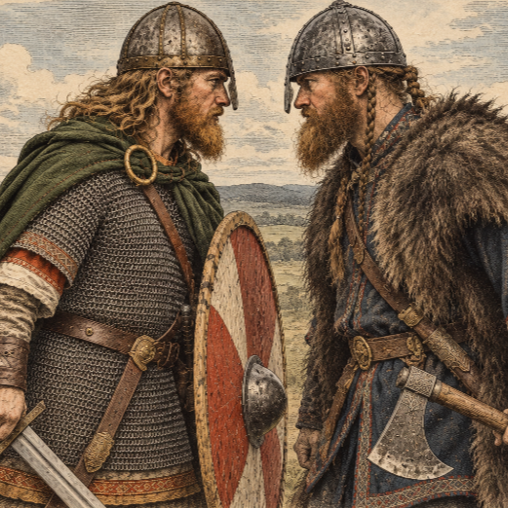
Amyas Godfrey: The Battle of Ethandun and the Unexpected Creation of England5pm Sunday 18 April 2027 The Battle of Ethandun in AD 878 was not simply a clash between two opposing peoples: Saxon and Viking, Christian and heathen, civilisation and barbarism. Rather, it was a confrontation between two culturally close cousins, each looking into a mirror and seeing different versions of their shared past and possible future. One reflected the epic warrior traditions of their Germanic ancestors; the other, the promise of wealthy, organised Christian kingdoms. Both societies stood at different stages of a transformation brought about by conversion to Christianity and the cultural changes that accompanied it: literacy and the written word, taxation and administration, increasingly stratified societies, and access to the wealth, learning and political networks of continental Europe and the Church. The circumstances that led to Ethandun were shaped by Alfred's determination not merely to survive, but to preserve and ultimately fulfil what he believed was his destiny. His conviction was rooted in a Christian vision of kingship, reinforced by his childhood visit to Rome and the special recognition he received from the Pope. Faced with the near destruction of his kingdom, Alfred's struggle was therefore about more than military survival. It was a struggle to preserve a vision of what Wessex, and perhaps the wider English people, might become. The outcome of the battle, and perhaps more importantly the decisions made in the settlement that followed, created the conditions in which Alfred's vision could flourish. Yet the victory did not simply establish the triumph of one culture over another. Instead, it began a process through which two closely related peoples, sharing much of their language, ancestry and warrior traditions, would increasingly become intertwined. Their interaction would enrich the English language, reshape the political and cultural landscape, and contribute to the development of a distinctive English Christianity and identity. The England that emerged under Alfred's grandson, Æthelstan, was far from the end of that story. The relationship between Saxons and Danes remained uneasy, and the kingdom would subsequently pass between English and Danish rulers. Yet through conflict, accommodation, conversion and integration, something new was taking shape: an identity that was neither exclusively Saxon nor Danish, and which would ultimately endure even the profound upheaval of the Norman Conquest. This talk explores how a battle fought on the Wiltshire downs became a turning point in the creation of England. It examines not only the military confrontation between Alfred and Guthrum, but the shared origins, competing ambitions and cultural exchanges that shaped its consequences. Ultimately, it asks whether Alfred's greatest achievement was not simply the survival of Wessex, but the articulation of an idea that would outlive him: the Angelcynn — an English people united by language, faith and an increasingly shared identity, drawn from different but closely related pasts. Amyas Godfrey is a former British Army officer, archaeologist (a graduate of University College London (UCL), and an enthusiastic explorer of Britain's history, its people and the events that have shaped the country we know today. After serving in the Army, Amyas went on to become Head of the UK Armed Forces Programme at the Royal United Services Institute (RUSI), the famous military think-tank set up by the Duke of Wellington to treat the study of the armed forces like other sciences. Alongside his military career, he has undertaken archaeological work both in Britain and overseas, developing a particular fascination with the relationship between landscape, conflict, migration and cultural identity. His history talks bring together archaeology, military history and storytelling, challenging familiar interpretations and exploring how the decisions, battles and movements of peoples and cultures centuries ago continue to influence our language, culture and national identity. [Return] |
Bratton History Association.
The Bratton History Association aims to provide all those curious about local history with an opportunity to meet, exchange ideas,
and discover more about the history of Bratton and Wiltshire. Activities include monthly meetings, talks by professional historians,
visits to places of interest to historians, and our own local history project.
Copyright Bratton History Association 2015-2026
Bratton History Association Privacy Statement
Copyright Bratton History Association 2015-2026
Bratton History Association Privacy Statement
Web Design by Blue Engine Web Development © 2008-2026